SYSTEM DESIGN

Stop guessing what “good” looks like.

Draw the system. Explain your tradeoffs. Get back feedback specific enough to act on. Keep grinding.

Overall Score

Design Twitter Feed

82
Data Storage
8
API Design
7
Scalability
9
Tradeoff Reasoning
8
Communication
7

Critique

“Your caching layer handles read-heavy loads well, but the write path lacks async processing — a bottleneck at scale.”

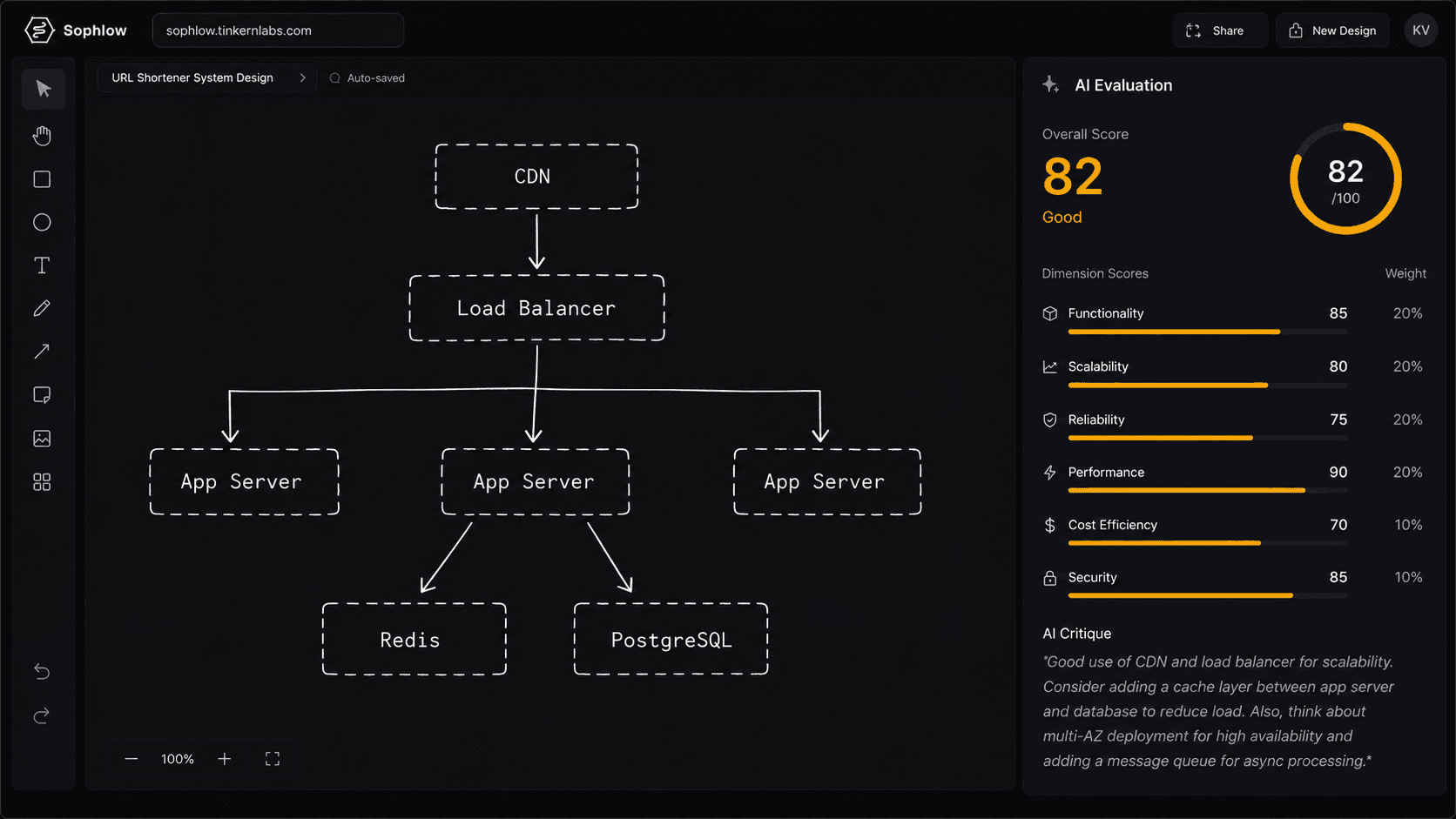
Sophlow canvas showing a system design diagram being scored by AI — Overall Score 82, with per-dimension feedback

The Loop

Build. Explain. Get better.

01

Draw your architecture

Sketch the system on an interactive canvas — components, connections, data flows. The same way you'd do it in front of an interviewer.

02

Explain your decisions

Write why. Which database and why not the other. What breaks at 10× traffic. Where you'd cut scope under pressure.

03

Get critiqued in seconds

Scored across 7 dimensions. Specific feedback on what's missing. Follow-up questions that probe the weakest parts of your design.

Problem Set

Real problems. Real rubrics.

Hand-curated problems with a 7-dimension rubric — the same criteria a staff engineer would use in an actual interview loop. Sign in to begin.

EasyFundamentals
Design TinyURL
Design a URL shortening service that creates short aliases for long URLs and redirects users efficiently at scale.
Sign in to practice →
MediumSocial
Design Twitter
Design a social media platform focused on short-form content and real-time feed delivery to hundreds of millions of users.
Sign in to practice →
MediumMessaging
Design a Chat System (WhatsApp)
Design a real-time messaging service that delivers text and media to individuals and groups at scale, with reliable offline delivery and presence tracking.
Sign in to practice →
HardReal-Time
Design Uber
Design a ride-sharing platform that matches riders with nearby drivers in real time, tracks trips, and handles millions of concurrent location updates.
Sign in to practice →

What you get

Feedback that doesn't let you off the hook.

  • Per-dimension scores across 7 rubric criteria — not a single pass/fail.
  • Specific critique: "Your write path has no async processing" — not "consider scalability."
  • Follow-up questions that probe the weakest parts of your design — like a real interviewer would.

Your next interview loop starts here.

Pick a problem, design your architecture, and get specific feedback in seconds.

No credit card required.